
After many years of debates and research, the International Union of Geological Science issued the final verdict: We do not (yet) live in the Anthropocene. This decision, despite its authority, will not quell the widespread usage of the term in non-geological scholarship and public debates. Specialist journals and numerous books are dedicated to exploring the …
Translating Indigenous spirituality into the language of science
In his essential book ‘Indigenous Economics’ Ronald Trosper, himself a member of the Confederated Salish and Kootenai Tribes of the Flathead Indian Reservation Montana, explains that Indigenous people often try to neutralize their spirituality when representing, advocating, and reinstating their ways of life in the context of mainstream society and politics. For example, when formulating …
Continue reading "Translating Indigenous spirituality into the language of science"
Ritual: Demarcating humanity from the technosphere
Max Weber famously associated capitalism with rationalization, an ‘iron cage.’ Indeed, we can speak of adapting human thinking, practices, and worldviews to the technosphere as the environment in which most humans today live. This translates into secularism, means-ends instrumentalism, rational technocracy, and many other social forms of Western modernity. In economics, one expression treats the …
Continue reading "Ritual: Demarcating humanity from the technosphere"
Cultural science: The study of more-than-human culture
Recently, I assumed the new task of editor-in-chief of the journal ‘Cultural Science. A multidisciplinary journal for the study of more-than-human culture’. In the Anthropocene, cultural science pursues the study of culture by liberating culture from anthropocentrism: We can no longer treat culture as a, or even ‘the’ human domain exclusively, both in the sense …
Continue reading "Cultural science: The study of more-than-human culture"
Hybrid Planet Earth: More-than-human infrastructural landscaping in the Anthropocene
The Earth sciences have suggested the notion of ‘hybrid planet’ Earth. In principle, this idea relates to Lovelock’s notion of Gaia in the sense that thermodynamic disequilibrium is conceived as an indicator of emergent and evolving planetary activity, in the case of Gaia the biosphere. Life transforms solar energy into processes that change the Earth’s …
On Tilo Wesche’s ‘Die Rechte der Natur’ (‘Rights of Nature’)
The German philosopher Tilo Wesche has published a book ‘Rights of Nature’ that submits an inspiring, important and comprehensive argument why ‘nature’ owns property that must be recognized in our legal systems and that would transform our societies to become ecologically sustainable, in an institutional regime of cohabitation between humans and ‘nature’ on the basis …
Continue reading "On Tilo Wesche’s ‘Die Rechte der Natur’ (‘Rights of Nature’)"
The Landscape as mediator between Technosphere and Biosphere
Recently I discovered landscape architecture and design as a fertile ground for thinking about the technosphere, especially in the context of the concept of 'landscape urbanism', a movement theorized by Charles Waldheim. This is a fascinating field because different from what most technosphere scholars do, the protagonists in this discipline mostly spend their time with …
Continue reading "The Landscape as mediator between Technosphere and Biosphere"
The commoning market economy
During inspiring discussions with Japanese economists, we came up with the idea of ‘commonism’: That would be defined as a market economy that is based on the commons as fundamental form of appropriation, and not private property. However, later I noticed that the term is already being used in a different way, namely referring to …
Designing the Technosphere for Life
Peregrine falcons are back in New York. They were inhabitants of Big Apple for many decades until DDT closed their fate. After DDT was prohibited, there were intensive efforts at restoring natural populations, and so citizens can again enjoy living together with the animals in what was originally designed as a purely human habitat, part …
Artificial Intelligence or Human Wisdom?
The tsunami of AI bots has been shaking our views about the future of humanity, both on a grand scale and in everyday life. This is my 50th post on this blog, so I deem this an appropriate topic. Will the technosphere ultimately take the seat of humanity in shaping the evolution of life on …
Reviving Vita Activa in the Technosphere
In his earlier post, Bronislaw Szerszysnky draws on Hannah Arendt’s influential work The Human Condition. I want to pick up this thread in reflecting on the relevance of her tripartite conception of Vita Activa, labour, work and action for understanding the relationship between humans and the technosphere. This distinction is perhaps confusing for the contemporary …
Infrastructure and co-evolutionary technology: Overcoming anthropocentrism in human niche construction
Almost half a century ago, niche construction theory was proposed as a major alternative or at least modification of the standard Neodarwinian model. This for two reasons. First, living beings change their environment in many ways, both as a side effect or with purposeful behaviour, such as nest or burrow construction. This changes the forces …
In praise of ‘kaputt’ technology
The German philosopher Oliver Schlaudt concludes his book on the ‘Technozän’ (‘technocene’; he told me, originally the idea was to title it ‘The technosphere’) with fascinating thoughts about debris and broken technological artefacts, inspired by a contribution of the philosopher Sohn-Rethel published in 1926 who praised ‘kaputt’ (broken, kaput) things. The argument is intriguing and …
Breaking the iron triangle: Technosphere, finance, land
Money is part and parcel of the technosphere. This includes the financial sector. Financial technology is all technical devices that manage financial objects aka assets. In old times, these were metal coins, gold and other valuables, and the means to store and transport them. Today, financial technology is mostly digital. Following social sciences approaches to …
Continue reading "Breaking the iron triangle: Technosphere, finance, land"
De-mystifying money: money as technology
In a recent paper, Inigo Wilkins and Bogdan Dragos develop the theory of money as a ‘machine’, building on earlier ideas of Mirowski and Cartelier. This theory perfectly dovetails with the arguments presented on money and the technosphere in this blog and in my related writings on the technosphere. If economists discuss technology, they rarely …
Who can stop the ‘blue acceleration’? The utopia of ‘ocean commons’
Recently I have been engaging in a collaboration with scholars in the field of geoethics and ocean sciences. We discuss the question whether and how the ocean can become an inspiration for developing entirely new ways of thinking about the future design of human societies and economies in the Anthropocene. One of them, Martin Bohle, …
Continue reading "Who can stop the ‘blue acceleration’? The utopia of ‘ocean commons’"
Ecology and More-than-human Property
This post was first published on the blog of the SFB Cooperative Research Center 'Structural Change of Property'. In responding to the challenge of climate change, the political focus is on decarbonizing the economy. This is certainly a priority, however it overlooks the issue that the catastrophic decline of biodiversity in recent decades was not …
Overcoming the Anthropocentric Epistemics of Economics
My colleague Christian Hederer and I are currently preparing our new book ‘A New Principles of Economics. The Science of Markets’ for production with Routledge. The book establishes economics ‘from scratch’, though relying on the accumulated research of economics in the past centuries. One fundamental difference to established approaches is starting out from Earth system …
Continue reading "Overcoming the Anthropocentric Epistemics of Economics"
‘Ways of Being’ in the Technosphere
James Bridle’s new book ‘Ways of Being. Beyond Human Intelligence’ bristles with inspiration for thinking about the technosphere, although he does not tie up with the Earth system sciences and economics in detail. His key concern is how we can approach both the living world and technology in similar frameworks of understanding more-than-human intelligence. This …
The Universal Commons
Recently, I have been digging deeper in the issue of property and ecology. As follow-up to my recent posts on Earth ownership and customary law, I received further inspiration from Karen Bradshaw’s book on 'Wildlife as Property Owners'. She argues that wildlife should be granted full property rights on their habitat. This is a complex …
Saving oil, saving Ukraine: Slow down the technosphere!
The IEA recently published a roadmap how to reduce oil consumption to an extent such that Russian oil would not be needed anymore. This roadmap is highly suggestive for the thesis that I presented in my previous post on Ukraine: The measures for reducing dependence on Russian oil are just the same as those ones …
Continue reading "Saving oil, saving Ukraine: Slow down the technosphere!"
The Great Trouble
For a German, Putin’s attack of the Ukraine and the atrocities committed against its people, which aim at annihilating its statehood, evokes bitter memories of 1939. Putin’s strategy of escalation will ultimately force the free world to stop him, unless brave Russians could topple him from power. Yet, this will take time. Understandably, NATO cannot …
Lessons of Customary Law for a Geocentric Legal Transformation
Hegel famously called institutions the ‚second nature’. Indeed, in modern societies, our relationship with the ‘first nature’ is deeply shaped by institutions that govern our interactions. In fact, what is ‘nature’ is not given, but is an institutional construct itself. Therefore, if we want to heal our broken relationship with the biosphere, we must change …
Continue reading "Lessons of Customary Law for a Geocentric Legal Transformation"
Who owns the Earth?
In the literature on global justice, we find the position that the Earth is commonly owned by humankind (advocated by Matthias Risse, for example). Although this smacks of biblical hegemony of ‘man’ over the rest of the biosphere, the protagonists claim that this can be reconciled with eco-centric views, although there are limitations: Human basic …
The Moral Economy of Growth and Markets: Chinese Narratives over two Millenia
The history of economic thought is written in a deeply Western-centric view. I recently consulted a volume of contributions to monetary theory before Adam Smith that only included European authors. But the first exposition of a theory of money and prices can be found in the Chinese text ‘Guanzi’ which combines different sources across five …
Continue reading "The Moral Economy of Growth and Markets: Chinese Narratives over two Millenia"
The Idea of ‘Co-evolutionary Technology’
Recently I collaborated with my Finnish colleagues Katriina Soini and Juha Hiedanpäa on fleshing out the idea of ‘co-evolutionary technology’. This builds on my earlier blogposts on technosystem services and nature-based solutions. Our launchpad is the critique of nature-based solutions, which are increasingly propagated as a panacea to meeting the problems of our times, especially …
Beyond ‘Nature-based Solutions’: The Concept of Co-creative Technology
A new journal has been launched: ‘Nature Based Solutions’. This raises the stakes for a concept that originally had no scientific status but emerged as a policy formula, similar to the earlier notion of ‘ecosystem services’. Ecological economics features many newly coined expressions that straddle the scientific and the policy communities, mainly because there is …
Continue reading "Beyond ‘Nature-based Solutions’: The Concept of Co-creative Technology"
A new view on GDP and economic growth
Ecological economists have criticized GDP for decades, yet progress is slow in switching to another measure of growth. We have plenty of alternatives, and government agencies worldwide have adopted a set of additional indicators relating to environment and human well-being. But GDP remains the key indicator of economic growth. One reason is that GDP offers …
The need for emancipating ourselves from the work ethic of the Technosphere
Recently, I read the book The Birth of Energy. Fossil Fuels, Thermodynamics, Energy & the Politics of Work by Cara New Daggett. This is a fascinating analysis of the role of thermodynamics as a worldview in the 19th century colonial and imperial expansion of capitalism. The linkage between science and ideology runs via Protestantism, with …
Continue reading "The need for emancipating ourselves from the work ethic of the Technosphere"
Why technological progress is a delusion and how can get rid of it
Economists and many others are deeply convinced that there is technological progress. Technological progress is a defining idea of Western modernity, originating from the Enlightenment. This is also recognized in the most comprehensive and apparently conclusive account of progress, Pinker’s book ‘Enlightenment Now’. So, it seems insane denying that there is technological progress. Yet, the …
Continue reading "Why technological progress is a delusion and how can get rid of it"
Anthropocentric ecosystem services versus geocentric technosystem services
In previous posts I have argued against the flawed anthropocentrism of the ecosystem services concept. But what is the alternative? How can we practically achieve a geocentric turn? Literally, that would mean that we reverse the direction of functional analysis. In the ecosystem concept, we ask what ecosystems do for us. Now we might ask …
Continue reading "Anthropocentric ecosystem services versus geocentric technosystem services"
Saving the Biosphere or Saving by the Biosphere? The Thermodynamics of Negative Interest Rates
A decade ago, the German economist Carl Christian von Weizsäcker mused that the phenomenon of declining opportunities for profitable investments that is behind the trend towards declining interest rates might reflect the Second Law of thermodynamics, in the sense that the more capital we accumulate, the more we must struggle to keep it in order, …
The Evolutionary Epistemology of the Technosphere
Technology and science are deeply interwoven. Often, this is interpreted in terms of scientific progress driving the emergence of new technologies. But historians of science have always emphasized the fact that science is also enabled by technology that is generated outside the epistemic venture of science. For example, artisanal advances in watchmaking contributed to the …
Continue reading "The Evolutionary Epistemology of the Technosphere"
Is Anthropocentrism Good Science? Why Sir Partha Got It Wrong
In these days, the ‘Dasgupta Review' receives much attention in policy circles and news reports. The Review pursues the laudable goal to include environmental concerns into economics and to show economic strategies for putting biodiversity at the centre of our efforts to cope with the challenge of climate change. The Review submits many important suggestions, …
Continue reading "Is Anthropocentrism Good Science? Why Sir Partha Got It Wrong"
Coral Cultivation: Technosphere on the Edge
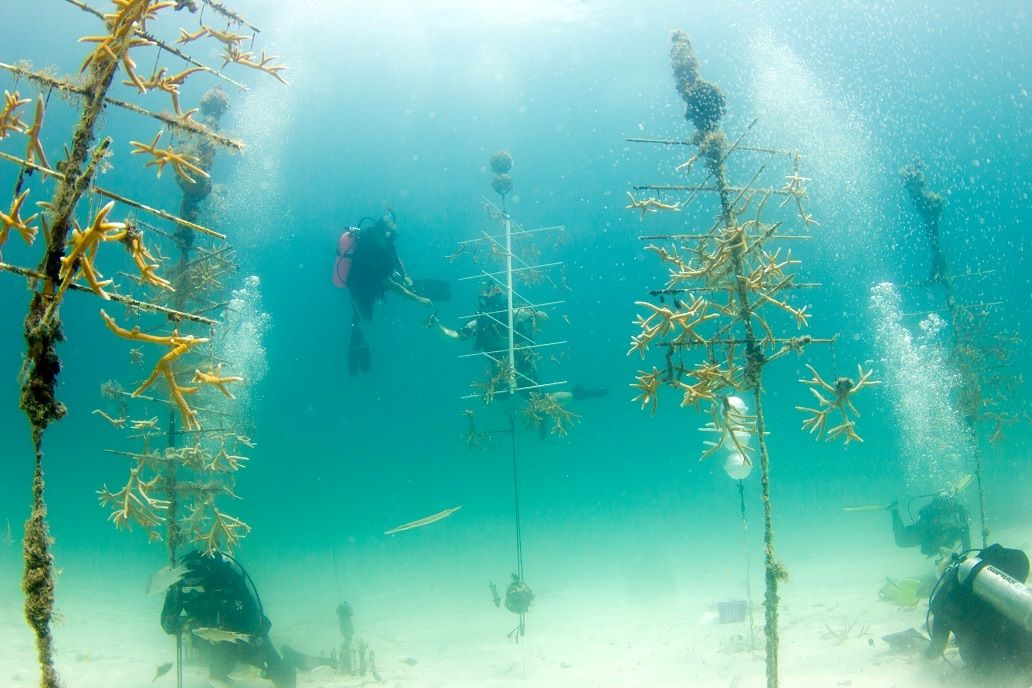
"Coral Cultivation: Technosphere on the Edge" by Boris Wille and Stefan Knauß shows how Marine-Biologists are trying fix the coral calamity by “coral cultivation”. These iniatives are particularly feasible to think with about Gaia 2.0 and the Technosphere.
Nature-based Solutions: ‘Naturally’ Growing the Technosphere
In recent initiatives of coping with the challenge of climate change and designing sustainable economies and societies, ‘nature-based solutions’ NBS have become a buzzword. Broadly speaking, this term refers to all sorts of alternatives to techno-engineering (‘grey’) measures directed at adapting and mitigating the impact of climate change which intentionally activate and strengthen ecosystems or …
Continue reading "Nature-based Solutions: ‘Naturally’ Growing the Technosphere"
Weighing the future more than the present: Paying a negative natural rate of interest to the biosphere
The interest rate is a crucial, if not the pivotal parameter in modelling challenges and strategies facing climate change. It reflects our stances towards the future. There are two basic, though conflicting principles how to determine it, as reflected in the seminal debate triggered by the Stern report in 2007, which opposed William Nordhaus’s position. …
The messiness of human life: the ultimate limit of technosphere expansion
Recently, the term ‘technosphere’ is increasingly used in a slightly different sense than in the Earth system context (see the new issue of ‘The Economist’ and the briefing that inspired and informed this post). The technosphere would be the world of the internet, roughly defined. This refers to the global and comprehensive connectivity and the …
Continue reading "The messiness of human life: the ultimate limit of technosphere expansion"
The Earth: A community of advantage
This post is the follow-up to the previous in presenting core ideas in my recent book chapter draft contributed to the volume edited by Martin Bohle “Geo-societal narratives - contextualising geosciences” (Palgrave). I present a solution to the dilemma in political epistemology that I pinpointed, namely that economists often argue that the market is beyond …
What is the purpose of the economy? The case for a geocentric turn in economics
Recently I have been working on a chapter contribution to a volume on geoethics edited by Martin Bohle “Geo-societal narratives – contextualising geosciences” (Palgrave). Dealing with literature that I was largely unfamiliar with helped me a lot to focus my thinking about ideas that I have been working on for years. This has been condensed …
Continue reading "What is the purpose of the economy? The case for a geocentric turn in economics"
The modern corporation: centre of power in the technosphere
There is a black hole in climate research, ecological economics and Earth system models: The corporation. Of course, corporations are recognized as actors, but what happens inside the corporation is normally not included in the macro-scale perspective that most Earth sciences research in the broadest sense adopts. Even when critics claim that the ‘anthropocene’ should …
Continue reading "The modern corporation: centre of power in the technosphere"
The technosphere as a computer: What are the thermodynamic implications?
In modern economics, information is arguably the core notion. Indeed, many economists would agree that the market is a giant distributed computer that processes information about scarcities of resources and generates prices that guide the actions of economic agents accordingly. However, economists rarely consider the physical side of information, although in practice that matters much, …
Continue reading "The technosphere as a computer: What are the thermodynamic implications?"
The city is dead. Long live the city?
This week edition of The Economist has a very stimulating briefing on New York and the impact of the Corona. Cities are under immense pressure, as they are by definition and purpose places where people are densely packed and crowd together. The article cites an intriguing observation by the Santa Fé physicist Geoffrey West: The …
Eigentimes in co-evolution of biosphere and technosphere: A challenge to policy design
The Corona crisis has highlighted a problem of considerable significance for the study of co-evolutionary processes: temporal dynamics and temporal coordination. In my 2002 book (in German) ‘Elements of Evolutionary Economics’ I devoted a full chapter to time and introduced the term ‘Eigentime’ that is mostly known from physics but is rarely used in other …
Universal basic income: Revolutionizing technosphere governance
Universal basic income UBI has been suggested by many authors as a major institutional innovation in designing the economy of the future. One motivation that increasingly gains acceptance is that it might be the solution to the problem of technological unemployment created by digitization and automation. In our context, that would translate into the assumption …
Continue reading "Universal basic income: Revolutionizing technosphere governance"
The Corona, Oil and the Challenge of Climate Change
Many observers have noticed that the current crisis could serve as a policy template for meeting the challenge of climate change. We collectively experience and manage a ‘de-growth’ process of unprecedented speed, and most governments are busy with finding ways how to recover growth. Yet, astute analysts such as the previous governor of the Bank …
Continue reading "The Corona, Oil and the Challenge of Climate Change"
Will Corona kill capitalism?
Economic historians know well that pandemics and existential crises can change the evolutionary trajectory of economic systems. The most illustrious case was the Black Death that ushered the demise of feudalism via its impact on labour supply and wages. In the 20th century, the Great Depression and WWII fundamentally changed the role of government in …
Do we consume too much?
A staple in debates over how we can counter the climate crisis is that we need to reduce our levels of consumption. Often, this appears to shift the brunt of the responsibility to the consumers aka citizens. But do we really consume too much? I have just completed reading this great achievement of historical scholarship, …
How to restore human agency in the technosphere
Most observers of the current climate crisis argue that we need fundamental changes of our lifestyles and economic policies. There is less emphasis on whether and how we must change the fundamental institutional structures of our economic systems. But when thinking about agency in the technosphere, institutions are central. If the technosphere follows its partly …
Continue reading "How to restore human agency in the technosphere"
Vaclav Smil on Growth: Seeing the Trees, but not the Forest
Vaclav Smil is one of the world’s leading thinkers on energy, society and nature. He has just published a volume on growth across many scales and domains (“Growth: From Microorganisms to Megacities”). As always, he presents an amazing richness of facts, often extremely enlightening. For example, he definitively shows that all thinking about ‘decoupling’ or …
Continue reading "Vaclav Smil on Growth: Seeing the Trees, but not the Forest"
Slavery, technosphere evolution and the future of human freedom
Sven Beckert’s book “Capitalism: A Global History” is filled with valuable insights. I was particularly impressed by his analysis of slavery. While it's well-known that slavery played a crucial role in colonialism and the social and economic structures of the United States after its founding, the extent and depth of the connection between capitalism and …
Continue reading "Slavery, technosphere evolution and the future of human freedom"
Towards a Pragmatist Thermodynamics of Technosphere Evolution
In his classic work “The Nature of Thermodynamics” (1943), P. W. Bridgman described thermodynamics as a branch of physics that carries a distinct human element. His operational approach to the philosophy of science emphasises grounding physical theories in human activities, such as controlled experiments conducted by scientists. Classical thermodynamics highlights this aspect by focusing on …
Continue reading "Towards a Pragmatist Thermodynamics of Technosphere Evolution"
On the thermodynamic limits to AI-powered economic growth
The newspaper The Economist recently published an interesting article summarising current debates and visions regarding the impact of AI on economic growth. One school of thought, popular among the titans of Silicon Valley, suggests that AI ushers in an era of explosive growth. This perspective is rooted in the Western conviction, maintained since the Enlightenment, …
Continue reading "On the thermodynamic limits to AI-powered economic growth"
From linear promises of Nature-based solutions to relational practices of Nature-based assemblages
This post has been published on the COEVOLVERS website and is co-authored by Simo Sarkki. Nature-based Solutions (NBS) promise numerous social, environmental, and economic benefits inspired and supported by nature. However, as the literature on NBS has evolved, more critical perspectives have emerged, emphasizing that naive assumptions about universal co-benefits must be abandoned. Nonetheless, the …
Beyond the end of human history: Towards the Confucian Anthropocene?
Francis Fukuyama’s book “The End of History and the Last Man” is often naively viewed as a premature celebration of the historical victory of liberal democracy and capitalism over all alternative forms of political organisation in large-scale, globally connected societies. However, this interpretation reflects a serious misunderstanding of Fukuyama’s erudite work on global history. He …
Continue reading "Beyond the end of human history: Towards the Confucian Anthropocene?"
A Degrowth Lab at an Unexpected Place
In the April 4, 2025 issue of “The Economist,” columnist "Free Exchange" provides a brief account of and reflection on a place that can be considered a “Degrowth Lab.” This is the Dzaleka refugee camp in Malawi, where approximately 52000 people have lived since 1994. The population is steadily increasing, with around 300 new residents …
Friedrich Schiller’s theory of aesthetic education and more-than-human play
During the height of critical theory in the 1960s, political aesthetics garnered significant attention. A key concept was earlier articulated in Ernst Bloch’s exploration of utopia, namely that the arts serve as a space for examining objective possibilities, thereby inspiring political action in the real world. Even earlier, these ideas were also expanded upon in …
Continue reading "Friedrich Schiller’s theory of aesthetic education and more-than-human play"
The aesthetics of more-than-human care
In sustainability sciences, the concept of "care" has become fundamental. This notion, which originated in ecofeminism, is understood as an ethical commitment to nurturing our planet and its living beings. It involves assuming responsibility and embracing a broad perspective that takes into account the concerns and vulnerabilities of other beings, as well as their material …
Beyond Neoliberalism: Trump’s Era and the Rise of Capitalist Fundamentalism
Most people evaluate the performance of the Trump presidency based on his personality. When attempting to categorize it politically, the term "fascism" is often mentioned, as exemplified by the memorable comments from Retired General Mark A. Milley. While Trump's ruthlessness and disregard for the separation of powers seem to support this characterization, there are significant …
Continue reading "Beyond Neoliberalism: Trump’s Era and the Rise of Capitalist Fundamentalism"
Does the technosphere exist?
Although Earth system sciences have embraced the term "technosphere" to conceptualize planetary processes, its use is not universal, and there are many sceptics. One might ask, "Does the technosphere actually exist?" There is a more cautious interpretation of the term, viewing it merely as a concept that serves specific modelling purposes without making any realistic …
 The technosphere, our agency, our planet
You must be logged in to post a comment.